










Related Posts





By Siena Brown • March 19, 2026 • 7 mins read


Active ingredients are the part of a skincare routine that drive the most visible results — and the part most likely to cause problems when used wrong. Over-exfoliation, barrier disruption, pilling, sensitisation — almost all of it comes down to actives applied in the wrong order, or in combinations that don’t work together.
For makeup wearers, those problems don’t just affect the skin’s health. They show up in how makeup applies and how long it holds. This article covers the layering principles that let actives do their job without compromising the skin surface that makeup depends on.
Active ingredients are the ones that actually change skin. Vitamin C brightens. Retinoids increase cell turnover. Acids exfoliate. Niacinamide regulates oil and supports the barrier. They’re worth understanding — because they’re also the ones most likely to cause issues when used incorrectly.
Order can make a difference when layering skincare. Vitamin C formulas can be sensitive to formulation and pH, which can affect how the product behaves on the skin (Pubmed). Layering from thinner to thicker products is a useful starting point, but there isn’t one universal order that works for every routine.
Get the layering wrong and it shows up fast. Pilling, irritation, a disrupted barrier — and all three affect how makeup sits on the skin and how it stays.
The morning routine for makeup wearers has specific constraints that an evening routine doesn’t. The morning routine for makeup wearers has one job everything else has to work around: leave a surface that primer and foundation can actually sit on. That means every step needs to absorb cleanly and layer without pilling.
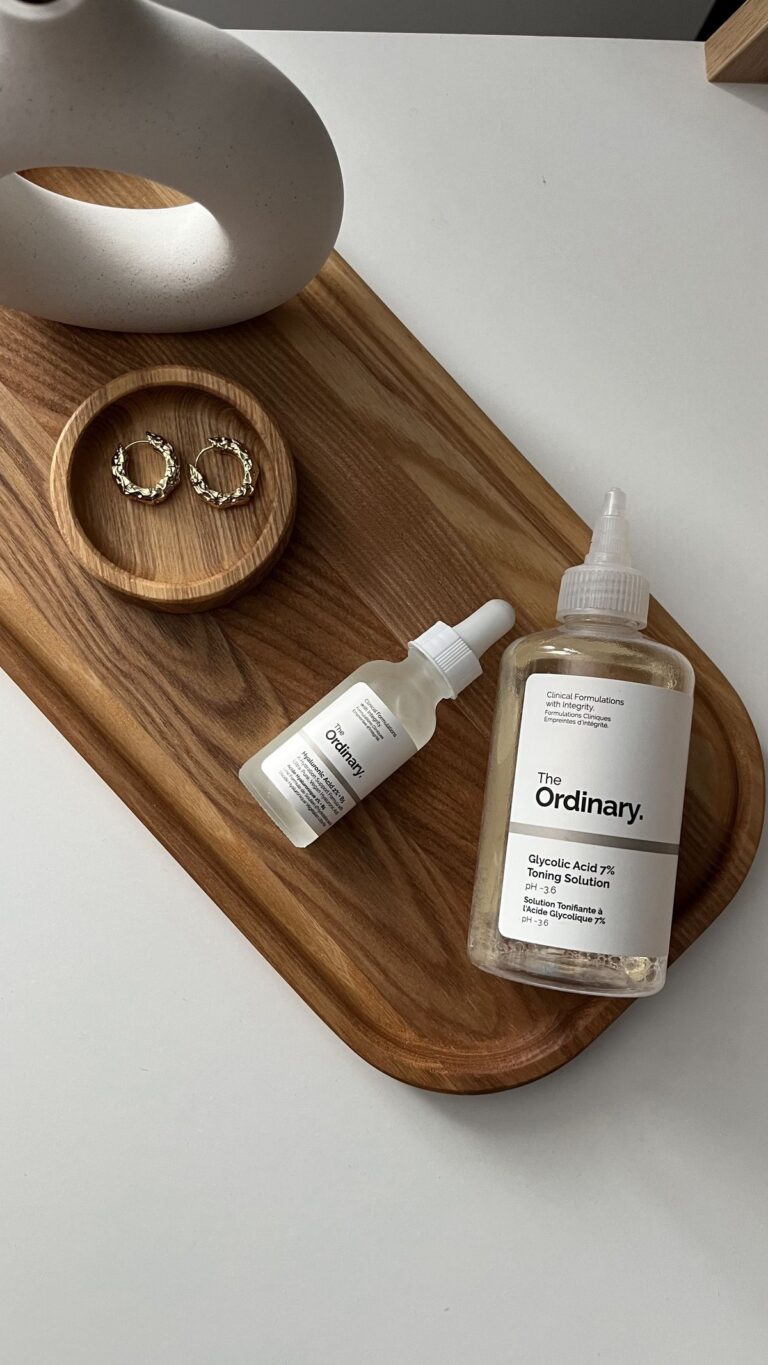
Step 1: Tone Set the base before your actives go on. This preps the skin and gets pH where it needs to be.
Step 2: Vitamin C The most useful morning active for makeup wearers. It protects against UV and pollution damage throughout the day, brightens over time, and supports collagen production. Stable derivatives like ascorbyl glucoside and sodium ascorbyl phosphate layer better under makeup than L-ascorbic acid. Wait two to three minutes before moving on.
Step 3: Niacinamide Genuinely useful for daily makeup wearers. It regulates sebum, reduces redness, and supports the barrier in a way that helps foundation sit more evenly and hold longer. It plays well with most other ingredients — one product containing it is enough.
Step 4: Moisturiser, then SPF Seal everything in and protect it.
What to skip in the morning: high-concentration L-ascorbic acid if it causes pilling, retinoids, and strong acids. These are evening ingredients. Using them before makeup increases irritation risk and leaves a disrupted surface that foundation won’t sit on cleanly.
The evening routine has more flexibility — nothing is going on top of the skin afterwards, so actives that would cause problems before makeup can do their best work without interference.
Step 1: Retinoid nights The most impactful evening active for long-term skin improvement. Retinoids can improve the appearance and texture of skin and may help reduce uneven pigmentation with consistent use (Pubmed). Results take time and vary from person to person. Introduce slowly — start with two nights a week, build to alternate nights, and only increase frequency once your skin has adapted. The texture improvements come without the irritation when you don’t rush it.
Step 2: Acid nights (alternate with retinoids, not the same night) AHAs like glycolic and lactic improve surface texture and support cell turnover. BHAs like salicylic work inside pores and suit oily and breakout-prone skin. PHAs are the gentlest option for sensitive skin that reacts to stronger acids. The key rule: don’t use an acid and a retinoid on the same night. Alternating them gives both ingredients the conditions to actually work.
Step 3: Active serum After actives, barrier support isn’t optional. A ceramide or peptide serum gives skin what it needs to repair overnight.
Step 4: Moisturiser A nourishing moisturiser seals everything in and supports recovery through the night.
The combination question comes up consistently, and most of the concern is more nuanced than it needs to be.
Vitamin C + Niacinamide: fine to layer
The concern that these two interact to create nicotinic acid (which can cause flushing) comes from research conditions that don’t apply to cosmetic concentrations. In practice, a vitamin C serum followed by a niacinamide moisturiser is completely fine — and commonly recommended.
Retinoids + Acids: alternate, don’t combine
Both increase cell turnover and both can irritate. Using them on alternate nights rather than the same night gives each ingredient room to work without compounding sensitisation. If your skin is particularly reactive, keep acids to one or two nights a week and retinoids to one or two different nights.
Vitamin C + SPF: use both, every morning
These work together, not against each other. Vitamin C enhances UV protection, and SPF prevents the UV damage that would undo the brightening work vitamin C is doing. They belong in the same morning routine.
Niacinamide + Hyaluronic Acid: a strong morning pairing for makeup wearers
Niacinamide handles oil regulation and barrier support. HA delivers hydration. Neither competes with the other — and together they create a skin surface that foundation adheres to and holds on through the day.
More is not more with actives. Most people figure this out the hard way — and honestly, it’s an easy mistake to make.
If you’re using retinoids, two to three times a week is enough to see real results. Daily use doesn’t speed things up, it just increases the chances of sensitisation. Same with strong acids — two to three times a week maximum. Vitamin C you can use daily without issue, as long as the formulation is stable. Niacinamide daily too.
Your skin will tell you if you’re overdoing it. If products that never bothered you are suddenly causing irritation, if you’re seeing persistent redness, if your skin looks and feels more uneven than before you started — pay attention to that. And if your foundation is breaking down faster than it used to, that’s your skin’s barrier telling you to slow down. Pull back before you add anything new.
The rule that actually saves you time in the long run: introduce one new active at a time. If you add a retinoid and a new acid in the same week and something goes wrong, you’ll have no idea which one caused it. One product, two weeks, assess — then bring in the next one. It takes longer to build your routine, but it’s the only approach that actually sticks.
The payoff of getting this right shows up exactly where it matters — in how your makeup applies and how long it holds.
Stick with retinoids consistently and over three to six months you’ll notice the kind of texture improvement that makes foundation apply more evenly and stay that way. Vitamin C works on the uneven pigmentation that usually means reaching for colour corrector or heavier coverage. Niacinamide may help reduce excess oil, which can be useful if you find foundation tends to break down during the day (Pubmed). Put all three together and you’re not just improving your skin — you’re reducing how much work your makeup has to do in the first place.
One more thing worth doing: adjust your routine with the seasons. Spring and summer mean more UV exposure, higher temperatures, and skin that’s generally more reactive. Pulling back slightly on acid and retinoid frequency when the weather warms up protects the barrier you’ve spent months building — and keeps your skin surface in the kind of condition where the rest of your routine can actually work.
For the morning routine that puts these principles into practice: [The Morning Skincare Routine for Flawless All-Day Makeup]. And for the vitamin C section specifically: [Vitamin C and Skin Brightness: What Makeup Lovers Need to Know].
Publishing industries for previewing layouts and visual mockups.