

Related Posts


By Siena Brown • June 23, 2026 • 5 mins read


Products featured on Ntrl Look are chosen independently by our editorial team. When you shop through our affiliate links, we may receive a commission at no extra cost to you.
Packing makeup for a trip usually goes one of two ways: everything gets thrown in “just in case,” or the bag gets stripped down to almost nothing and regretted by day two. Neither approach accounts for what actually changes on holiday — heat, humidity, limited counter space, and less time for a full routine most mornings.
Professional travel-ready kits are built around multi-use products and formulas that hold up outside normal conditions, not just smaller versions of an everyday routine. Here’s the edit: what genuinely earns a spot in a holiday makeup bag, and what’s safe to leave behind.
A heavier, full-coverage foundation is often the wrong call for holiday conditions, even if it’s the go-to at home. Heat and humidity change how thicker formulas wear, and a base built for air-conditioned indoor days can look and feel heavy fast once temperatures and activity levels rise.
Tinted moisturiser or a lightweight skin tint tends to be a more realistic base for travel — enough coverage to even things out without the weight. Concealer is arguably the one truly multi-use product worth prioritising: spot coverage, under-eye brightening, and in a pinch, a dab on the cheeks works as cream blush. Setting powder or spray suited specifically to humidity, rather than a standard formula, makes a meaningful difference in how long the base actually holds through a hot day.
Cream products generally travel and perform better in heat than powder counterparts. A cream blush or cream eyeshadow blends more easily on warm, slightly oily summer skin than a powder version, which can grab unevenly once skin has more natural shine than usual.
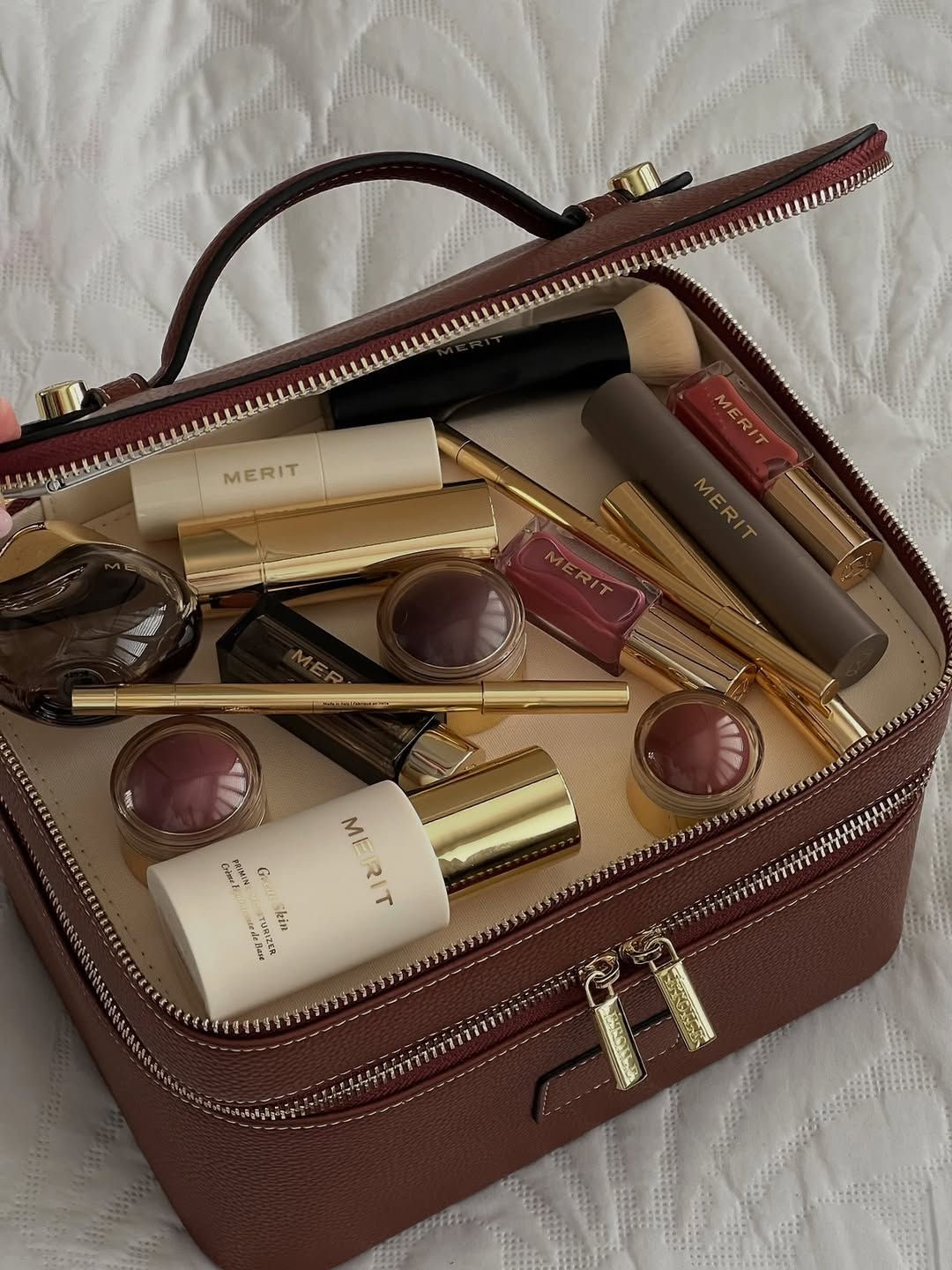
Stick-format products are worth prioritising for a different reason: efficiency. A stick that works for cheeks, lips, or even a wash of eye colour cuts down on both the number of products packed and the time spent applying them. It’s worth being honest about what “multi-use” actually means here — a product that can genuinely serve two or three purposes without compromising the result, not a product marketed as multi-use that still requires a separate item for each area to look finished.
Some products simply don’t belong in a travel kit, regardless of how often they’re used at home. Anything with a short shelf life once opened — certain natural or preservative-light formulas — is more likely to degrade faster in heat, particularly if the bag sits in a hot car or a non-air-conditioned room at any point.
Tools that don’t travel well, or that aren’t essential for a simplified routine, are usually the easiest things to cut: a full brush set rarely gets used in full on a trip, and a few multi-use brushes cover most needs. The same logic applies to full palettes — a curated handful of shades, chosen for the trip specifically, tends to get more actual use than an entire palette packed “just in case.” Being honest about what gets used on a normal travel morning, rather than an idealised one, is the fastest way to edit a bag down to what matters.
Skincare matters as much as makeup in a holiday kit, particularly SPF. Travel-size sunscreen is worth checking for actual reapplication suitability — not every travel-size format is built to deliver a meaningful layer of product, even if it’s marketed for on-the-go use.
A simplified prep routine — cleanser, a lightweight moisturiser, and SPF — is usually enough to protect skin under increased heat and sun exposure without adding a full skincare routine to the packing list. This connects directly back to how the base makeup above performs: well-protected, properly prepped skin holds foundation and concealer better than skin that’s been left unprotected through a day of travel and sun exposure.
Preventing breakage and melting in transit comes down to a few practical habits: cream and liquid products packed in a way that limits shifting, anything pressed (like powder) cushioned to avoid cracking, and heat-sensitive items kept out of direct sun exposure in transit when possible.
Bag size should scale to trip length rather than defaulting to “everything that might get used.” For a week-long trip, a genuinely edited kit — the base products, two or three multi-use cream or stick items, SPF, and a couple of tools — usually covers what’s needed. Decanting into smaller containers makes sense for liquids that would otherwise take up disproportionate space; full-size packaging makes more sense for anything used daily where running out mid-trip would be a bigger problem than the extra space. Before departure, a quick check of expiration dates, potential leaks, and heat sensitivity saves the more common travel makeup frustrations before they happen.
A holiday makeup bag doesn’t need everything from an everyday routine — it needs the handful of products built to perform under different conditions with less time and less space. Edited down to genuinely multi-use, heat-stable pieces, packing takes less thought and the routine holds up better once you’re actually there.
Publishing industries for previewing layouts and visual mockups.